
 Zionist Israel and Apartheid South Africa: Civil society and peace building in ethnic-national states (Routledge Studies on the Arab-Israeli Conflict)
 05:07 |
  Posted by
Unknown
Posted by
Unknown

Zionist Israel and Apartheid South Africa: Civil society and peace building in ethnic-national states (Routledge Studies on the Arab-Israeli Conflict)
 |
|
 |
|
This book is a comparison of two ethnic-national "apartheid" states – South Africa and Israel – which have been in conflict, and how internal dissent has developed. In particular it examines the evolution of effective white protest in South Africa and explores the reasons why comparably powerful movements have not emerged in Israel. The book reveals patterns of behaviour shared by groups in both cases. It argues that although the role played by protest groups in peace-building may be limited, a tipping point, or ‘magic point’, can become as significant as other major factors. It highlights the role played by intermediate variables that affect the pathways of protest groups: such as changes in the international system; the visions and strategies of resistance movements and their degree of success; the economic relationship between the dominant and dominated side; and the legitimacy of the ideology in power (apartheid or Zionism). Although the politics and roles of protest groups in both cases share some similarities, differences remain. Whilst white protest groups moved towards an inclusive peace agenda that adopts the ANC vision of a united non-racial democratic South Africa, the Jewish Israeli protest groups are still, by majority, entrenched in their support for an exclusive Jewish state. And as such, they support separation between the two peoples and a limited division of mandatory Palestine / ‘Eretz Israel’. This timely book sheds light on a controversial and explosive political issue: Israel being compared to apartheid South Africa. ...Read more |
Do you buy the product ....
People buy the item below.
Products are as follows.
Click on the image to select the product in stock. Models and colors.
Click on the image to see the price inside.
and see the details inside in image
Can not find the product you want.
Using the scanner or click on the image to the many other products
Product Description Click the product image.
Thank you for using our services and property purchased with us.
 Labels:
Africa,
Apartheid,
ArabIsraeli,
building,
Conflict,
ethnicnational,
Israel,
Routledge,
Society,
States,
Studies,
Zionist
|
Labels:
Africa,
Apartheid,
ArabIsraeli,
building,
Conflict,
ethnicnational,
Israel,
Routledge,
Society,
States,
Studies,
Zionist
|
 0
comments
0
comments
Famous Landmark Documentary On Racism In A United States Neighborhood / Video Film
12:10 |
Posted by
Unknown
The Black middle-class Myers family moves into all-white Levittown, PA in August, 1957, and are snubbed and mistreated, in this powerful landmark documentary showcasing racism in the United States. This movie is part of the collection and courtesy of the Academic Film Archive of North America from www.archive.org; Producer: Lee Bobker/Lester Becker. Racism, by its simplest definition, is discrimination based on the racial groups to which people belong. People with racist beliefs might hate certain groups of people according to their racial groups. In the case of institutional racism, certain racial groups may be denied rights or benefits, or get preferential treatment. Racism typically points out taxonomic differences between different groups of people, even though anybody can be racialised, independently of their somatic differences. According to the United Nations conventions, there is no distinction between the term racial discrimination and ethnic discrimination. While the term racism usually denotes race-based prejudice, violence, discrimination, or oppression, the term can also have varying and hotly contested definitions. Racialism is a related term, sometimes intended to avoid these negative meanings. According to the Oxford English Dictionary, racism is a belief or ideology that all members of each racial group possess characteristics or abilities specific to that race, especially to distinguish it as being either superior or inferior to another racial group or ...
Tenther News 12-26-12: NDAA, Obamacare and Agenda 21 Nullification in the States
08:28 |
Posted by
Unknown
tenthamendmentcenter.com This week's episode is made possible in part by the Tenth Amendment Center bookstore.. We've hand-picked the top-10 books for you to read. From history to how-to, get a lifetime education with the Tenther 10 -- online at tenthamendmentcenter.com ***** On what was either an ironic day, or just a sick joke played on the American people, last week on December 18th, the US House of Representatives removed whatever weak support their was for protecting due process from the 2013 National Defense Authorization Act, the NDAA. What made it an historic day? Well 68 years earlier on December 18, 1944, the Supreme Court decided the Korematsu case. This was the one where the supremes determined that is was "constitutional" for the federal government to throw people of Japanese descent into concentration camps based on their ethnic background. In both situations, the US federal government took due process and shredded it. But people around the country are beginning to realize that NDAA detention powers are a problem created by the federal government -- so relying on those same people to fix the problem THEY created is just plain idiotic. Already the state of Virginia has passed a law to nullify NDAA earlier this year and more than 15 local governments have done the same. Nevada State Senator Don Gustavson (R-Sparks) recently filed a bill draft request for the Nevada Liberty Preservation Act. While the final language has not been completed, the bill will ...
Ethnonationalist Conflict in Postcommunist States: Varieties of Governance in Bulgaria, Macedonia, and Kosovo (National and Ethnic Conflict in the 21st Century)
02:24 |
Posted by
Unknown
|
[else] [endif] |
|
 |
|
Ethnonationalist Conflict in Postcommunist States investigates why some Eastern European states transitioned to new forms of governance with minimal violence while others broke into civil war. In Bulgaria, the Turkish minority was subjected to coerced assimilation and forced expulsion, but the nation ultimately negotiated peace through institutional channels. In Macedonia, periodic outbreaks of insurgent violence escalated to armed conflict. Kosovo's internal warfare culminated in NATO's controversial bombing campaign. In the twenty-first century, these conflicts were subdued, but violence continued to flare occasionally and impede durable conflict resolution. |
Ethnonationalist Conflict in Postcommunist States: Varieties of Governance in Bulgaria, Macedonia, and Kosovo (National and Ethnic Conflict in the 21st Century)
Do you buy the product ....
People buy the item below.
Products are as follows.
Click on the image to select the product in stock. Models and colors.
Click on the image to see the price inside.
and see the details inside in image
Can not find the product you want.
Using the scanner or click on the image to the many other products
Product Description Click the product image.
Thank you for using our services and property purchased with us.
CERTAIN CONTENT THAT APPEARS ON THIS SITE COMES FROM AMAZON SERVICES LLC. THIS CONTENT IS PROVIDED 'AS IS' AND IS SUBJECT TO CHANGE OR REMOVAL AT ANY TIME.
Labels:
Books,
Bulgaria,
Century,
Conflict,
Criticism,
Dance,
ethnic,
Ethnonationalist,
Galaxy,
Governance,
Kosovo,
Macedonia,
national,
Postcommunist,
Readings,
States,
Theory,
Varieties
|
0
comments
America's Japanese Hostages: Peruvian Japanese in the United States During World War Two (Praeger Studies on Ethnic and National Identities in Politics)
23:46 |
Posted by
Unknown
 |
America's Japanese Hostages: Peruvian Japanese in the United States During World War Two (Praeger Studies on Ethnic and National Identities in Politics) |
$105.00
|
America's Japanese Hostages: Peruvian Japanese in the United States During World War Two (Praeger Studies on Ethnic and National Identities in Politics)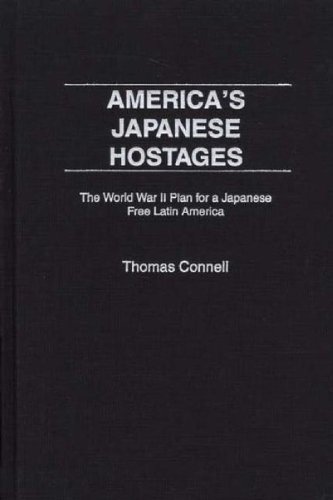
 America's Japanese Hostages: Peruvian Japanese in the United States During World War Two (Praeger Studies on Ethnic and National Identities in Politics)
 Overviews Connell uncovers a little known World War II top secret program. The United States demanded that Latin American governments deport—or allow the United States to take—anyone of Japanese ancestry and place them in camps in Texas and New Mexico. The plan was to trade them for American civilians held by the Japanese. Although Peru was the most enthusiastic participant in this program, expelling nearly 5,000 Peruvian citizens of Japanese ancestry, other Latin American countries participated as well. Connell traces the reasons for prejudice and discrimination, the specific programs, and the post-war efforts of those held in American relocation camps to secure restitution. Through the wide use of oral interviews as well as documents, Connell shows the very human side of this effort, which in many ways parallels the discrimination Americans of Japanese ancestry faced during the war. This book provides a thorough and intriguing story of interest to general readers as well as scholars, students, and other researchers involved with World War II and Latin American history. |
Do you buy the product ....
People buy the item below.
Products are as follows.
Click on the image to select the product in stock. Models and colors.
Click on the image to see the price inside.
and see the details inside in image
Can not find the product you want.
Using the scanner or click on the image to the many other products
Product Description Click the product image.
Thank you for using our services and property purchased with us.