
 Fon Lao Huam Phao for the InterAction Forum 2010 @ DC Convention Center
 07:38 |
  Posted by
Unknown
Posted by
Unknown
Dance Lao Huam Phao performed by the Swan Dange troupe (SDT) & LAWA (Lao American Women's Association) for the InterAction Forum 2010's gala dinner @ the Washington DC Convention Center on June 3, 2010. InterAction is the largest coalition of US-based international nongovernmental organizations (NGOs.) Musical intruments (for other performers) on the stage led to last-minute changes in our dance routine. We had to improvise during the dance without even discussing anything prior. Still, we did all right.
The Geographic Origins of Uzbek-Tajik Tensions (Dispatch)
22:30 |
Posted by
Unknown
Stratfor analyst Eugene Chausovsky traces the origins of Uzbekistan and Tajikistan's current tensions to Stalin's division of the Fergana Valley. For more, visit: www.stratfor.com
 Labels:
Center,
Channel,
component,
Dispatch,
Geographic,
Origins,
Reserve,
Something,
stereo,
System,
Tensions,
Theres,
Think,
UzbekTajik
|
Labels:
Center,
Channel,
component,
Dispatch,
Geographic,
Origins,
Reserve,
Something,
stereo,
System,
Tensions,
Theres,
Think,
UzbekTajik
|
 0
comments
0
comments
Ethnic Nationalism in Korea: Genealogy, Politics, And Legacy (Studies of the Walter H. Shorenstein Asia-Pacific Research Center)
00:42 |
Posted by
Unknown
 |
Ethnic Nationalism in Korea: Genealogy, Politics, And Legacy (Studies of the Walter H. Shorenstein Asia-Pacific Research Center) |
$27.95
|
Ethnic Nationalism in Korea: Genealogy, Politics, And Legacy (Studies of the Walter H. Shorenstein Asia-Pacific Research Center)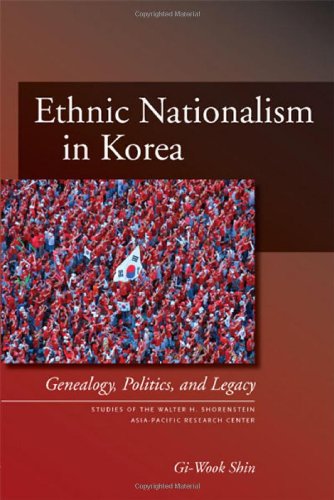
 Ethnic Nationalism in Korea: Genealogy, Politics, And Legacy (Studies of the Walter H. Shorenstein Asia-Pacific Research Center)
 Overviews This book explains the roots, politics, and legacy of Korean ethnic nationalism, which is based on the sense of a shared bloodline and ancestry. Belief in a racially distinct and ethnically homogeneous nation is widely shared on both sides of the Korean peninsula, although some scholars believe it is a myth with little historical basis. Finding both positions problematic and treating identity formation as a social and historical construct that has crucial behavioral consequences, this book examines how such a blood-based notion has become a dominant source of Korean identity, overriding other forms of identity in the modern era. It also looks at how the politics of national identity have played out in various contexts in Korea: semicolonialism, civil war, authoritarian politics, democratization, territorial division, and globalization. |
Do you buy the product ....
People buy the item below.
Products are as follows.
Click on the image to select the product in stock. Models and colors.
Click on the image to see the price inside.
and see the details inside in image
Can not find the product you want.
Using the scanner or click on the image to the many other products
Product Description Click the product image.
Thank you for using our services and property purchased with us.
Labels:
Artists,
AsiaPacific,
Center,
Essential,
ethnic,
Genealogy,
Korea,
Legacy,
Nationalism,
Politics,
Research,
Series,
Shorenstein,
Studies,
Turner,
Walter
|
0
comments
The Colors of Poverty: Why Racial and Ethnic Disparities Exist (National Poverty Center Series on Poverty and Public Policy)
05:46 |
Posted by
Unknown
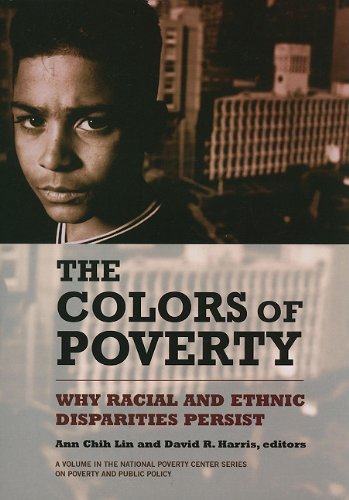

The Colors of Poverty: Why Racial and Ethnic Disparities Exist (National Poverty Center Series on Poverty and Public Policy)
Do you buy the product ....
People buy the item below.
Products are as follows.
Click on the image to select the product in stock. Models and colors.
Click on the image to see the price inside.
and see the details inside in image
Can not find the product you want.
Using the scanner or click on the image to the many other products
Product Description Click the product image.
Thank you for using our services and property purchased with us.
| Given the increasing diversity of the nation--particularly with respect to its growing Hispanic and Asian populations--why does racial and ethnic difference so often lead to disadvantage? In The Colors of Poverty, a multidisciplinary group of experts provides a breakthrough analysis of the complex mechanisms that connect poverty and race. The Colors of Poverty reframes the debate over the causes of minority poverty by emphasizing the cumulative effects of disadvantage in perpetuating poverty across generations. The contributors consider a kaleidoscope of factors that contribute to widening racial gaps, including education, racial discrimination, social capital, immigration, and incarceration. Michèle Lamont and Mario Small grapple with the theoretical ambiguities of existing cultural explanations for poverty disparities. They argue that culture and structure are not competing explanations for poverty, but rather collaborate to produce disparities. Looking at how attitudes and beliefs exacerbate racial stratification, social psychologist Heather Bullock links the rise of inequality in the United States to an increase in public tolerance for disparity. She suggests that the American ethos of rugged individualism and meritocracy erodes support for antipoverty programs and reinforces the belief that people are responsible for their own poverty. Sociologists Darren Wheelock and Christopher Uggen focus on the collateral consequences of incarceration in exacerbating racial disparities and are the first to propose a link between legislation that blocks former drug felons from obtaining federal aid for higher education and the black/white educational attainment gap. Joe Soss and Sanford Schram argue that the increasingly decentralized and discretionary nature of state welfare programs allows for different treatment of racial groups, even when such policies are touted as "race-neutral." They find that states with more blacks and Hispanics on welfare rolls are consistently more likely to impose lifetime limits, caps on benefits for mothers with children, and stricter sanctions. The Colors of Poverty is a comprehensive and evocative introduction to the dynamics of race and inequality. The research in this landmark volume moves scholarship on inequality beyond a simple black-white paradigm, beyond the search for a single cause of poverty, and beyond the promise of one "magic bullet" solution. ANN CHIH LIN is associate professor in the Gerald R. Ford School of Public Policy and Department of Political Science at the University of Michigan. DAVID R. HARRIS is professor of sociology and deputy provost at Cornell University. A Volume in the National Poverty Center Series on Poverty and Public Policy |
 |
|
CERTAIN CONTENT THAT APPEARS ON THIS SITE COMES FROM AMAZON SERVICES LLC. THIS CONTENT IS PROVIDED 'AS IS' AND IS SUBJECT TO CHANGE OR REMOVAL AT ANY TIME.
Labels:
Center,
Colors,
Disparities,
ethnic,
Management,
national,
Palgrave,
Policy,
Poverty,
Public,
Racial,
Series,
Skills
|
0
comments